
Special events for Halloween
Design and management of special events for Halloween in Shopping and Leisure Centers.
Halloween Events
We create original events for your clients to believe again… to believe in the magic of details…., to believe in the illusion of enjoying every moment…, to believe that any moment can be surprising.
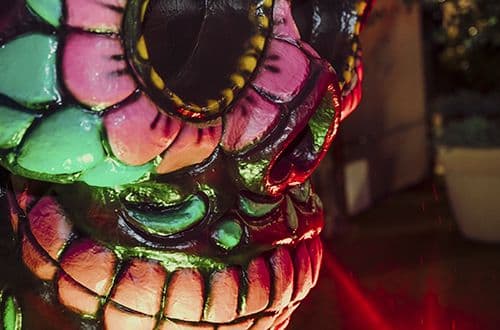
Giant Skulls Exhibition (6 Units)
Exhibition of Mexican style Halloween Skulls, although they can be adapted to the client’s needs by customizing them with other characterizations and even leaving them blank so that they can be artistically decorated. On the back-flat part you can include the message you want: The logo of the Shopping Center and/or some reference to Halloween.
Request more information from Calaveras Gigantes
The Ghost Village
This village can be placed all together in the same space, or in different parts of the mall, in three different spaces. Each “house” has a game of skill related to the Halloween holiday.
Request more information about the Ghost Village
Halloween’s Hunter
On the giant screen will appear different typical characters of Halloween (bats, ghosts, skulls, …) the game is that by launching a “magic balls” – totally “soft” – against the screen we have to hit only in the pumpkins that appear. each success will give us a score.
Request more information about Halloween’s Hunter
The Forest of Shadows (Photocall)
This is an action designed so that all customers can take a “terrifying” photo that they can send to their friends, acquaintances, relatives,… and even encourage them to tag it by offering them scary prizes!
Request more information about Photocall
The Haunted House
In this house the paintings have a life of their own. As soon as you touch them, extraordinary things happen. If our clients dare, they will be able to walk around and touch the different paintings and enjoy a terrifying and original experience.
Giant Pumpkin (with smoke and light effects)
Performance of actors with a mobile pumpkin of 2m in diameter + trolley with light and smoke effects. The action, itinerant, includes two professionally characterized extras who are in charge of setting the atmosphere of the event.
Request more information about Giant Pumpkin
School of Brujos/as
What witchdoctor has not liked to make his own potions!…. by putting together a little of this, a little of that… this is what we propose to our little apprentice witchdoctors! Let them look for their ingredients, mix them and they can make their own potions!
Request more information from Escuela de Brujos/as
Spider’s Game
In this game of skill we will see if the little ones, and the not so little ones, are able to throw the balls and hit the inner target but without the balls getting caught in the web of the biggest spider you’ve ever seen! Whoever manages to do it, has a prize for sure!
Request more information about Spider’s Game
Origin of Halloween
Trick or treat, pumpkins, vampires, witches and skeletons… Today, Halloween has become an increasingly popular holiday around the world, thanks to the influence of the American entertainment industry. The word “Halloween” has its origin in the expression “All Hallow Eve” and is strongly linked to the Christian tradition, although it is also influenced by the ancient Celtic and Roman beliefs that celebrated the end of the harvest season and honored the dead, known as Samhain and Mundus Patet.
On Halloween, ancient commemorations of the dead and the reign of the dead are mixed with current customs such as the famous trick or treat, which originated in the early twentieth century.
All Saints’ Day
The feast of All Saints has its origins in the ancient belief of the Church, which held that martyrs deserved to have a special day to remember their sacrifice. This led Pope Boniface IV to establish, in the 7th century, a day dedicated to commemorate Christian martyrs on May 13. One hundred years later, Pope Gregory III extended this celebration to all saints recognized by the Catholic Church and changed its date to November 1.
It seems clear that in choosing this date they clearly intended to replace pagan festivities related to the dead, such as the Celtic Samhain or the Mundus Cereris. These celebrations were rooted in the regions where the Church had expanded, adapting their rituals to previous beliefs. Consequently, around November 1, other festivities appeared, such as Halloween on the eve, and All Souls’ Day on the following day, which eventually intermingled with the original celebration.
Halloween Activities
Among the most prominent Halloween activities are the classic “trick or treat”, participating in costume parties, shaping pumpkins into skull shapes and lighting them with a candle, bonfires, playing scary games, trick-or-treating, visiting scary attractions, telling scary stories and watching scary movies, among others.
For some people, this holiday involves the observance of Christian religious practices associated with All Hallows’ Eve, such as attending religious services and lighting candles on the graves of the deceased.
Historically, some Christians observed abstinence from meat on All Hallows’ Eve, a custom reflected in the choice of vegetarian foods on this vigil day, such as apples, potato pancakes and soul memorial cakes.
Halloween Costumes
In general, Halloween costumes used to follow the pattern of scary figures such as vampires, ghosts, skeletons, grotesque witches and demons, costumes from horror movies, tv and cinema, Halloween pumpkins, Halloween costumes, Day of the Dead (Catrina), Zombies, Corpse Bride, Ghosts, Gothic, Vampires, Skeletons and death, Scream, Jason, Chucky, The Purge, IT, Annabelle, Sinister Girl, Devil Doll.
Over time, the type of costumes expanded to include characters such as ninjas and princesses.
The custom of dressing up and guising was common in Scotland and Ireland during Halloween celebrations in the late 19th century. The Scottish tradition is called “guising” because of the costumes or outfits worn by the children. In Ireland and Scotland, the masks are known as “false faces,” a term recorded in Ayr, Scotland, in 1890 by a Scotsman who described the costumed children as “the little ones were at it already, running about with their ‘false faces’ and turnip lanterns in hand.”
Costumes became popular at Halloween festivities in the United States in the early 20th century for both adults and children, especially as the tradition of trick-or-treating spread in Canada and the United States in the 1920s and 1930s.
Eddie J. Smith, in his book “Halloween, Hallowed is Thy Name,” offers a religious perspective on the use of costumes on All Hallows’ Eve. He suggests that by dressing up as creatures that used to inspire fear, people can mock Satan, whose dominion has been defeated by our Savior. Depictions of skeletons and the dead are traditional decorations used as reminders of mortality.
Halloween Themes